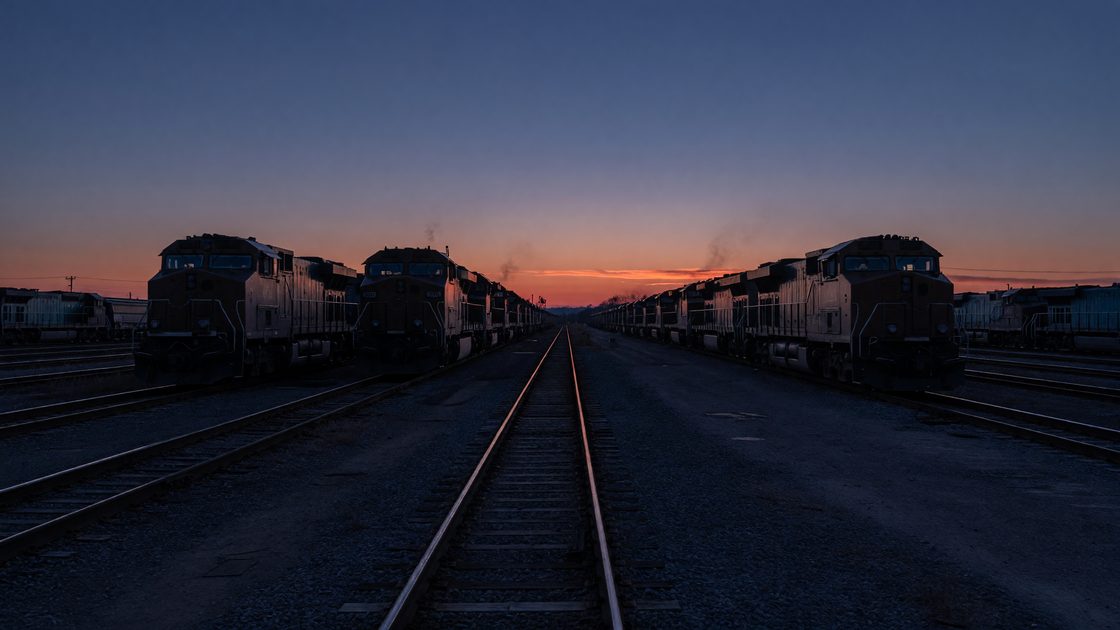
Fleet management sits at the intersection of two demands that are structurally in tension: operations wants every locomotive available for dispatch as often as possible, and maintenance needs guaranteed downtime to perform inspections and programmed service without which the fleet cannot legally or safely run. A rail operation of any size — Class I, short line, or industrial — succeeds or struggles at fleet management based on how well it resolves that tension in the way it builds its maintenance and dispatch schedules together, rather than treating them as two separate departments negotiating over the same locomotives. See our locomotive preventive maintenance overview for the maintenance side of this equation.
Locomotive Availability as a Planning Constraint
Fleet managers plan around an availability rate — the percentage of the fleet expected to be dispatchable at any given time, net of units in scheduled maintenance, running repairs, or held for defects. A fleet’s real availability rate depends on fleet size, unit reliability, shop capacity, and how tightly the maintenance schedule is staggered across the fleet. Smaller fleets, common among short lines and industrial railroads, have less statistical cushion — losing even one or two units to unplanned maintenance represents a much larger percentage hit to available power than the same absolute loss would on a large Class I fleet.
Staggering Maintenance Across the Fleet
A fleet that schedules all its units’ periodic and annual FRA inspections around the same calendar interval creates predictable availability crunches every time that interval comes due. Staggering inspection due-dates across the fleet — so that only a small, predictable fraction of units are due for major service in any given month — smooths demand on shop capacity and keeps availability more consistent for dispatch planning. This staggering has to be actively managed, because units naturally cluster toward the same due dates over time as fleets age together (units purchased in the same batch, or overhauled in the same program, tend to come due together unless deliberately separated).
Regulatory Compliance as an Operational Constraint, Not Just a Paperwork Requirement
FRA inspection and hours-of-service requirements are sometimes treated by dispatch planning as a compliance department’s problem rather than a hard operational constraint equivalent to physical locomotive availability. A unit whose periodic inspection has come due cannot be dispatched regardless of physical condition or operational need, which means the compliance calendar functions exactly like a maintenance-bay reservation from a scheduling perspective — it removes a unit from the available pool on a specific date whether or not the shop has capacity that week. Fleet management systems that model compliance due-dates as a first-class scheduling constraint, alongside physical maintenance and shop capacity, produce more realistic availability forecasts than systems that bolt compliance on as an afterthought.
Short Line and Industrial Rail Fleet Considerations
Short line and industrial railroads typically operate smaller, often older, and more heterogeneous fleets than Class I railroads — units acquired secondhand from multiple prior owners, in varying maintenance condition, sometimes without complete maintenance history. Fleet management in this environment leans more heavily on establishing a clean maintenance-history baseline for each newly acquired unit (a full condition assessment at acquisition, independent of whatever records came with the purchase) and on relationships with contract maintenance shops, since in-house shop capability is often more limited than a Class I railroad’s dedicated facilities.
Data Quality as the Foundation of Fleet Planning
Every fleet management practice above depends on accurate, timely data: current maintenance status per unit, current compliance due-dates, shop capacity and current workload, and dispatch demand forecasts. Fleets that maintain this data in systems that are actually kept current — rather than in records that lag actual shop activity by days or weeks — make materially better scheduling decisions, because the tension between dispatch demand and maintenance windows can only be resolved well if both sides are looking at the same, current picture of fleet status.
Power Assignment and Consist Planning
Beyond availability forecasting, fleet managers make daily power-assignment decisions — which specific locomotives get assigned to which trains — that interact with maintenance scheduling in ways that are easy to overlook. Assigning a unit that is due for scheduled maintenance in three days to a long-haul train that will not return to a maintenance-capable terminal for five days effectively forces a choice between running the unit past its due date or diverting the train, neither of which is a good outcome. Fleet management systems that check a unit’s upcoming maintenance and compliance due-dates against a train’s planned itinerary before assignment — rather than relying on dispatchers to remember which units are coming due — catch this class of scheduling conflict before it becomes an operational problem instead of after.
Consist composition (which locomotives run together on a given train, and in what order) also interacts with maintenance planning, particularly for fleets running mixed equipment generations. A consist that pairs a unit with a known developing issue alongside otherwise healthy units concentrates risk in a way that a fleet manager aware of individual unit condition can deliberately avoid, assigning a unit with a flagged condition to shorter, lower-consequence routes until its maintenance issue is addressed rather than to the longest or most critical train on the schedule.
Communication Between Maintenance and Operations
Many of the scheduling conflicts described above are not failures of planning tools so much as failures of communication between maintenance and operations groups that, in practice, often work from separate systems and separate priorities. Maintenance planners see the compliance calendar and shop capacity; dispatchers and operations planners see customer commitments and train schedules. Fleets that establish a shared, current view of both — a single system or a regular structured handoff where both groups see the same upcoming due-dates and the same shop capacity constraints — resolve far fewer conflicts through last-minute negotiation than fleets where each group works from its own separate picture of fleet status and only discovers a conflict when a train is already committed to a unit that cannot legally run.
Frequently Asked Questions
What is locomotive fleet availability rate and why does it matter?
Availability rate is the percentage of a fleet’s locomotives that are dispatchable at a given time, net of units in scheduled maintenance, running repairs, or held for defects. It matters because dispatch planning depends on a realistic availability forecast — planning against total fleet size rather than realistic availability leads to chronic power shortages during maintenance-heavy periods.
Why do fleets stagger maintenance schedules across units?
Staggering prevents multiple units from coming due for major inspection or service in the same period, which would otherwise create a predictable availability crunch every time that interval recurs. Units naturally cluster toward the same due dates as fleets age together unless a fleet manager deliberately separates them.
How does FRA compliance affect fleet scheduling?
A locomotive whose periodic or annual FRA inspection has come due cannot be dispatched regardless of its physical condition, so compliance due-dates function as a hard scheduling constraint equivalent to a maintenance-bay reservation — not merely a paperwork deadline that can be worked around operationally.
How is fleet management different for short line railroads compared to Class I railroads?
Short lines typically operate smaller, older, and more heterogeneous fleets, often acquired secondhand with incomplete maintenance history, and rely more on contract maintenance shops than in-house facilities. This shifts fleet management priorities toward establishing a clean maintenance baseline at acquisition and toward managing external shop relationships rather than internal shop capacity.
Sources
Federal Railroad Administration, Locomotive Safety Standards, 49 CFR Part 229, and the American Short Line and Regional Railroad Association provide the regulatory and short-line-specific operational context referenced above.