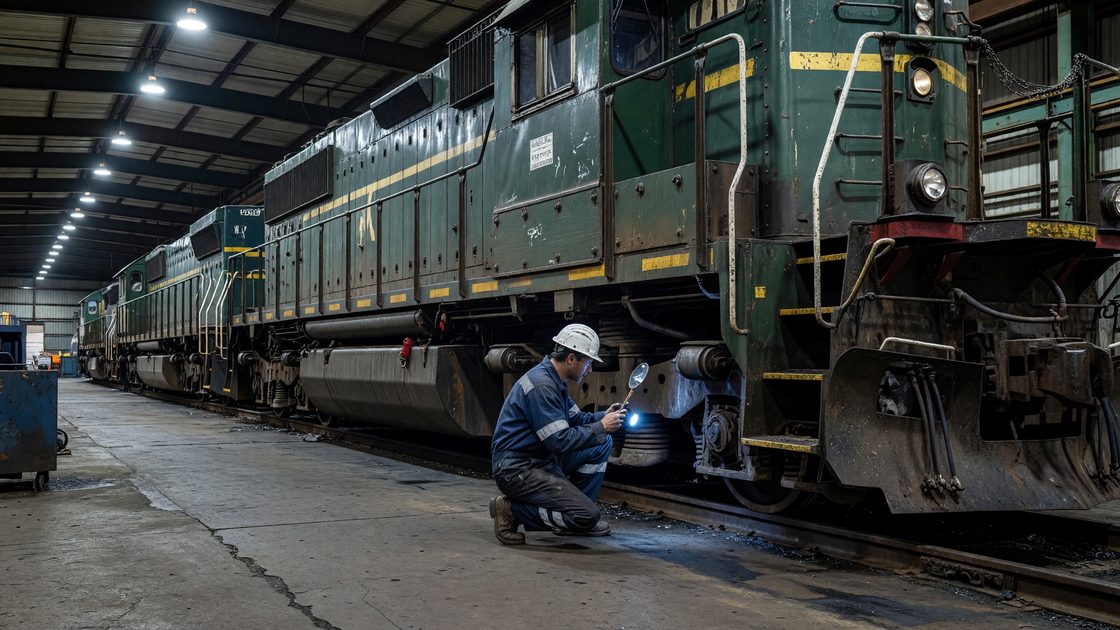
A locomotive preventive maintenance program only works if it is structured around the intervals that actually govern the equipment — not a generic schedule borrowed from another fleet type. Locomotives combine a diesel engine, a large DC or AC electrical system, mechanical running gear, and air brake equipment, each with its own wear pattern and its own regulatory inspection requirement. A maintenance program that treats all of that as one undifferentiated “PM” misses the failure modes that actually take a unit out of service.
The Regulatory Floor: FRA Inspection Intervals
The Federal Railroad Administration sets the minimum inspection cadence for locomotives under 49 CFR Part 229. A daily inspection covers safety-critical items — brakes, lights, horn, and visible mechanical condition — and must be documented before the unit enters service. A periodic inspection, typically at 92-day intervals, is more thorough and covers items that do not need daily eyes but cannot be allowed to drift for a full annual cycle. The annual inspection is the deepest mandated check, covering structural and mechanical items that are impractical to verify more often.
These intervals are a regulatory floor, not a maintenance philosophy. A program built to exactly meet the 92-day and annual minimums, with nothing in between, will still let components fail between inspections — the FRA schedule is designed to catch safety-relevant defects, not to optimize component life or minimize unplanned failures.
Running Repairs vs. Programmed Maintenance
Most fleets separate maintenance into two tracks. Running repairs address defects found during daily inspection or reported by crews — a leaking air hose, a failed headlight, a tripped ground relay. These get fixed as they surface, usually at a home terminal or designated repair point, and the goal is turning the unit around quickly without deferring anything safety-relevant.
Programmed maintenance is scheduled work tied to mileage, hours, or calendar interval rather than a reported defect: engine oil and filter changes, traction motor inspections, brake shoe replacement, wheel truing. This is where a maintenance program’s real quality shows up, because programmed maintenance is discretionary in timing — a fleet can push an interval or tighten it, and that decision compounds over the life of the unit.
Where Programs Typically Fail
Three patterns show up repeatedly in fleets with higher-than-expected locomotive failure rates:
Interval creep. A maintenance interval set conservatively at fleet introduction gets stretched over years of budget pressure, one deferral at a time, until it no longer reflects the component’s actual wear rate. Nobody makes a single bad decision; the interval just drifts.
Missing failure-mode feedback. Programs that do not feed unscheduled-failure data back into interval-setting keep running the same schedule regardless of what is actually failing between inspections. A traction motor that keeps failing at 80% of its rated interval is telling the program something the calendar schedule is not listening to.
Undocumented deviations. Running repairs performed outside the home shop, especially by contract labor at an away terminal, sometimes do not make it into the unit’s maintenance history in a form the home shop can use for trend analysis. A defect fixed twice at two different terminals looks, on paper, like two unrelated single incidents rather than a recurring problem.
Building an Interval Schedule That Reflects Real Wear
A defensible preventive maintenance schedule starts from OEM-recommended intervals (typically expressed in engine hours or miles), adjusts for the unit’s actual duty cycle — a switcher working a yard all day wears differently than a road unit running long consists at speed — and then gets refined against the fleet’s own failure history. Componentized tracking (by wheel set, by traction motor, by turbocharger) rather than by locomotive number lets a shop see which specific components are underperforming their interval, independent of which unit they happen to be installed on this month.
Documentation as a Maintenance Tool, Not Just a Compliance Record
FRA-required inspection records are often treated purely as a compliance artifact — filed, retained for the required period, rarely reviewed again. Fleets that get more value from their maintenance programs use the same records as a diagnostic dataset: trending which components fail before their scheduled interval, which units accumulate more running repairs than the fleet average, and which shops or contract vendors produce work that holds up versus work that generates repeat defects.
Shop Capacity and Scheduling Trade-offs
Even a well-designed interval schedule fails in practice if the shop cannot execute it on schedule. Programmed maintenance competes for bay space and skilled labor hours with running repairs, which are inherently unpredictable — a shop cannot decline an unscheduled brake defect to keep a scheduled wheel-truing slot. Fleets with chronic capacity shortfalls tend to solve this by deferring programmed work first, since it does not carry the same immediate safety consequence as an unaddressed running-repair defect. That is a reasonable emergency response, but a program that resolves capacity conflicts the same way every month is not managing capacity — it is quietly re-defining its maintenance intervals downward without ever changing the documented schedule.
A shop capacity plan that accounts for the historical rate of running repairs (not just the theoretical programmed-maintenance workload) gives a more honest picture of what a maintenance organization can actually deliver. Some fleets address this by pre-scheduling programmed maintenance with deliberate slack — booking a wheel-truing job with buffer time around it rather than back-to-back with the next unit — so that an unscheduled defect on a different locomotive does not automatically bump the programmed job to next month.
Contract Shops and Away-Terminal Work
Larger fleets, and especially short lines and industrial railroads without their own full-service shop, rely on contract maintenance providers for some portion of programmed work and for running repairs that occur away from the home terminal. This introduces a documentation seam: a contract shop’s records need to flow back into the unit’s central maintenance history in a form the home shop can actually use for trend analysis, not just as a paid invoice on file. Fleets that standardize the data fields a contract vendor must report — component identifier, meter reading at time of service, parts replaced, defect code — get usable trend data from outside work. Fleets that accept whatever format each vendor happens to submit end up with a maintenance history that has real gaps precisely where contract work was performed.
Frequently Asked Questions
How often does the FRA require locomotive inspections?
The FRA requires a daily inspection before a locomotive enters service, a periodic inspection at intervals not to exceed 92 days, and an annual inspection covering structural and mechanical items not practical to check more frequently. These are minimums set by 49 CFR Part 229, not a complete maintenance philosophy.
What is the difference between running repairs and programmed maintenance?
Running repairs address defects found during inspection or reported by crews and are performed as needed. Programmed maintenance is scheduled work tied to mileage, hours, or calendar interval — oil changes, traction motor service, wheel truing — and is where a fleet’s maintenance quality is really determined.
Why do preventive maintenance intervals drift over time?
Interval creep happens gradually: budget pressure leads to one deferred service, then another, until the actual interval no longer matches the component’s real wear rate. No single decision causes it — it accumulates because nobody is tracking the cumulative drift against the original engineering basis.
Should maintenance intervals be based on OEM recommendations or fleet-specific data?
Both. OEM-recommended intervals are the starting point, but they assume a typical duty cycle. A unit’s actual duty cycle — yard switching versus road service — changes real component wear rates, so a program that never adjusts OEM baselines against its own failure history will eventually mis-time its own maintenance.
Sources
Federal Railroad Administration, 49 CFR Part 229 — Railroad Locomotive Safety Standards, governs minimum inspection intervals referenced above.