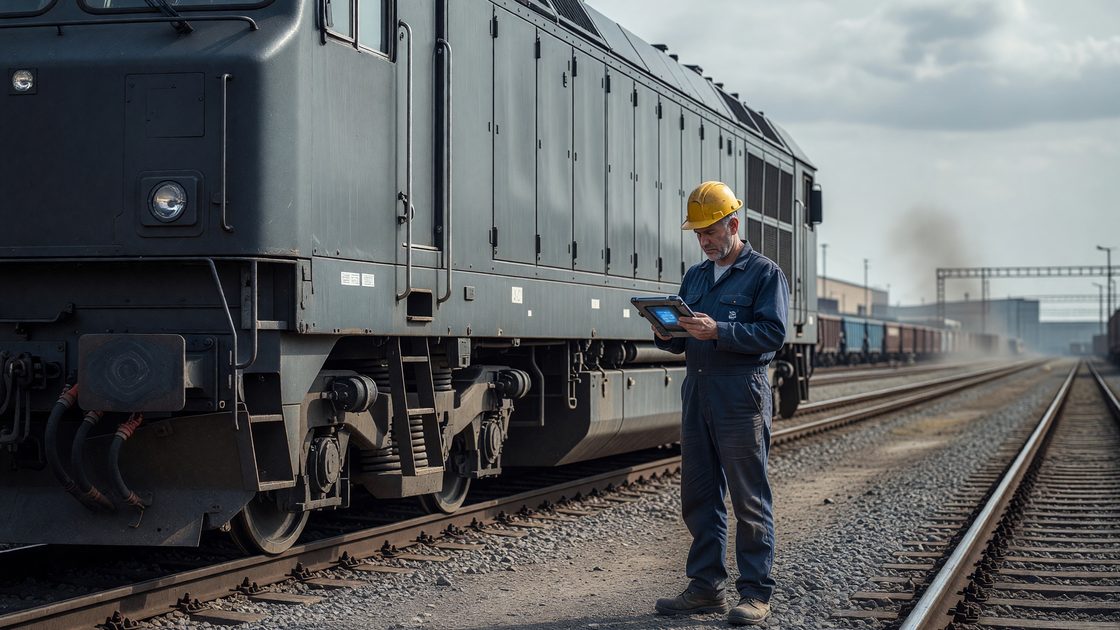
Predictive maintenance is not a new idea in rail — fleets have trended failure data and adjusted intervals against real-world wear rates for decades, as we covered in our overview of locomotive preventive maintenance program structure. What has changed in the last several years is the volume and granularity of data available to do that trending against, and the emergence of machine-learning models capable of finding failure patterns in that data that a human analyst reviewing spreadsheet trend lines would likely miss. The result is a genuine shift in what “predictive” can mean for a maintenance program — but it depends entirely on data infrastructure that many fleets, especially smaller ones, do not yet have in place.
From Scheduled Intervals to Condition-Based Triggers
Traditional preventive maintenance schedules components by elapsed time, mileage, or engine hours — a reasonable proxy for wear when better information is not available, but a proxy nonetheless. Predictive maintenance instead triggers service based on a component’s actual measured condition: vibration signature, temperature trend, electrical insulation resistance trend, oil analysis results. A traction motor bearing showing an early vibration signature consistent with developing wear gets flagged for inspection regardless of where it sits in the calendar interval, while a bearing showing a clean signature at the scheduled interval date may be left in service rather than pulled unnecessarily.
This shift only works if sensor data is actually being collected continuously or at frequent intervals, rather than spot-checked during scheduled inspections — which is the practical barrier for many fleets. Retrofitting onboard condition-monitoring sensors to an existing fleet, or installing wayside monitoring systems that read passing equipment, is a real capital investment, and the return on that investment depends on having the analytical capability to actually use the resulting data.
What Machine Learning Adds Beyond Threshold Alarms
A simple condition-monitoring system flags a component when a measured value crosses a fixed threshold — useful, but limited to failure modes anticipated in advance by whoever set the threshold. Machine-learning models trained on historical sensor data paired with actual failure outcomes can identify subtler, multivariate patterns: a specific combination of temperature trend and vibration frequency that precedes a particular bearing failure mode weeks before any single measurement crosses an obvious threshold, or a pattern across multiple locomotives in the same duty cycle that indicates a systemic issue with a component batch rather than an individual unit problem.
This is where the technology’s real value shows up — not in replacing the maintenance planner’s judgment, but in surfacing patterns from a volume of sensor data no human analyst could realistically review manually across an entire fleet, and prioritizing which flagged anomalies deserve inspection first.
Data Infrastructure Is the Actual Bottleneck
The limiting factor for most fleets considering predictive maintenance is not the availability of machine-learning technology — it is data infrastructure. A useful predictive model requires historical sensor data paired with confirmed failure outcomes, in consistent format, across enough units and enough time to train a model that generalizes rather than overfitting to one fleet’s specific quirks. Fleets with incomplete maintenance records, inconsistent data formats between contract shops and in-house maintenance, or limited sensor coverage across the fleet do not have the data foundation a predictive model needs, regardless of how capable the modeling technology itself has become.
This is a genuine, practical constraint, and it means predictive maintenance adoption in rail has followed a predictable pattern: larger fleets with more consistent internal data practices and greater capital available for sensor retrofits have moved first, while smaller operators — many short lines and industrial railroads — are still working from a maintenance-history baseline too thin to support model training, independent of whether they want the technology.
Where a Human Still Needs to Be in the Loop
A predictive model’s output is a flagged anomaly and a confidence estimate, not a maintenance order. Every fleet running predictive maintenance in production still routes flagged components through a human maintenance planner or technician for inspection and disposition — the model narrows where attention should go; it does not replace the judgment call about what to actually do once a technician has eyes on the flagged component. Fleets that have tried to automate maintenance dispatch directly off model output, without a human review step, have generally found the false-positive rate too costly in unnecessary shop visits to sustain — a caution worth taking seriously for any fleet evaluating a vendor’s predictive maintenance pitch that promises to remove maintenance planners from the loop entirely.
A Realistic Adoption Path
Fleets considering predictive maintenance get more value starting from a narrow, well-understood failure mode — traction motor bearing wear is a common starting point, given its well-characterized vibration signature — rather than attempting a fleet-wide, all-component rollout at once. A narrow pilot builds the internal data discipline (consistent sensor installation, consistent failure-outcome logging) that a broader rollout later depends on, and produces an early, demonstrable result that justifies further capital investment in sensor coverage and data infrastructure.
Vendor Evaluation: What to Ask Before Committing
Predictive maintenance is an active vendor market, and fleet managers evaluating a proposal benefit from asking specific questions rather than accepting a vendor’s aggregate accuracy claims at face value. What failure modes was the model actually trained to detect, and on what fleet’s data — a model trained primarily on one railroad’s traction motor data may not transfer cleanly to a different fleet’s duty cycle and equipment mix without retraining. What is the model’s false-positive rate in practice, not just in a vendor’s internal validation, since a model that generates too many low-value inspection flags will train maintenance staff to deprioritize its alerts over time, defeating the purpose entirely. And critically, what sensor infrastructure does the fleet need to install or already have in place for the model to function, since a predictive maintenance vendor’s software is only as useful as the sensor data feeding it.
Fleets that have gone through a disappointing predictive maintenance pilot most often report the same root cause: a vendor’s model was purchased before the fleet had assessed whether its own data infrastructure was mature enough to support it, resulting in a system with too little quality data to generate trustworthy predictions, regardless of how sound the underlying modeling technology was.
The Regulatory and Insurance Angle
Predictive maintenance does not currently substitute for any FRA-required inspection — a flagged component still requires the same physical inspection and disposition process a manually scheduled inspection would require, and FRA periodic and annual inspection intervals remain mandatory regardless of what a predictive model indicates. Where predictive maintenance data does increasingly matter is in the conversation between a fleet and its insurers and internal risk-management functions, since a documented, data-driven maintenance program that can demonstrate proactive component monitoring is generally viewed more favorably than a program relying solely on the regulatory minimum — though this is a secondary benefit of adopting the technology, not the primary justification for the capital investment it requires.
Frequently Asked Questions
What is the difference between predictive maintenance and traditional preventive maintenance?
Preventive maintenance schedules service based on elapsed time, mileage, or engine hours as a proxy for component wear. Predictive maintenance instead triggers service based on a component’s actual measured condition — vibration, temperature, insulation resistance, oil analysis — allowing service to be timed to real wear rather than a calendar proxy.
What data does a fleet need before adopting AI-based predictive maintenance?
A useful predictive model needs historical sensor data paired with confirmed failure outcomes, in consistent format, across enough units and time to generalize. Fleets with incomplete maintenance records or inconsistent data formats between contract shops and in-house work do not have the foundation a predictive model requires, regardless of the modeling technology’s capability.
Does AI-based predictive maintenance replace the need for a maintenance planner?
No. Predictive models flag anomalies and estimate confidence; a human maintenance planner or technician still reviews flagged components and makes the disposition decision. Fleets that have tried to automate maintenance dispatch directly from model output without human review have generally found the false-positive rate too costly to sustain.
What is a good first component to target with predictive maintenance?
Traction motor bearing wear is a common starting point because its vibration signature is well-characterized and relatively easy to monitor reliably. A narrow pilot on one well-understood failure mode builds the sensor and data-logging discipline a broader predictive maintenance program later depends on.
Sources
Federal Railroad Administration research on locomotive condition monitoring and the Association of American Railroads technology resources provide industry context for the practices described above.