Condition monitoring in rail maintenance splits into two fundamentally different sensor architectures, and the choice between them — or, increasingly, the combination of both — shapes what a fleet can actually detect and how early it can detect it. Onboard sensors travel with the locomotive and report continuously; wayside systems are fixed installations along the track that inspect passing equipment at specific points in the network. Each has real strengths the other cannot fully replace, which is why industrial IoT deployment in rail maintenance increasingly means both, working together, rather than a choice of one over the other. See our article on AI-assisted predictive maintenance for how the data these systems generate feeds into predictive models.
Onboard Sensors: Continuous Data, Limited Vantage Point
Onboard condition-monitoring sensors — vibration sensors on traction motors and bearings, temperature sensors throughout the propulsion and electrical systems, oil condition sensors — travel with the unit and can report continuously regardless of where the locomotive is in the network. This continuous coverage is the core advantage: a developing fault does not need to wait for the unit to pass a fixed inspection point to be detected, and trend data accumulates across the unit’s entire operating history rather than only at discrete checkpoints.
The trade-off is installation and maintenance cost per unit, and the fact that onboard sensors only see what they are physically mounted to observe — a traction motor vibration sensor tells you about that motor, not about wheel-rail interface condition or track geometry, which require an entirely different sensing approach.
Wayside Systems: Fleet-Wide Coverage Without Per-Unit Instrumentation
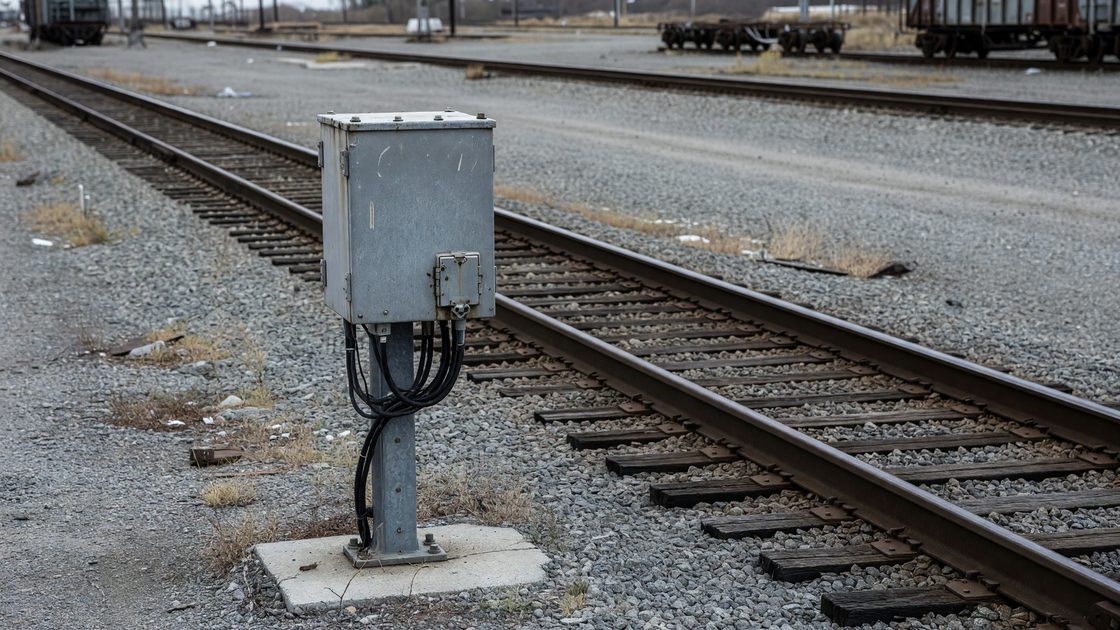
Wayside detection systems — hot bearing detectors, wheel impact load detectors, acoustic bearing detectors, machine-vision-based defect detection — are fixed installations that inspect every unit passing a given point, without requiring any sensor installed on the locomotive itself. This means a wayside system provides coverage across an entire fleet, including locomotives and rail cars that are not separately instrumented, and can detect certain failure modes — wheel defects, hot bearings, some structural issues — that are difficult or impractical to monitor from an onboard sensor.
The trade-off is that wayside systems only see equipment at the moment it passes the installation point. A fault developing between two passes of a wayside detector is invisible to that system until the next pass, and a railroad’s ability to detect a developing problem quickly depends on how densely wayside systems are deployed across the network and how frequently a given unit passes one.
Machine-Vision Inspection at Wayside Points
A newer category of wayside system uses camera arrays and machine-vision models to inspect passing equipment for visible defects — missing or damaged components, coupler condition, brake rigging issues — that traditionally required a human inspector walking the train. These systems do not replace the regulatory requirement for human inspection where FRA rules specify it, but they add continuous automated screening between required human inspections, flagging equipment for closer human review when the vision model detects an anomaly.
The practical value of machine-vision wayside inspection depends heavily on the model’s false-positive and false-negative rates in the specific operating environment it is deployed in — lighting conditions, weather, and the visual variety of equipment passing the detector all affect model performance, and a system tuned on one railroad’s equipment mix does not necessarily perform the same on another’s without retraining.
Data Integration Across Sensor Types
The real value of an industrial IoT deployment in rail maintenance comes from integrating data across sensor types and locations — an onboard vibration trend on a specific traction motor, correlated with a wayside hot-bearing-detector reading from the same axle at a different point in the network, gives a more complete condition picture than either data source alone. This requires a data architecture that can associate readings from different systems with the same physical component across time and location, which is a harder integration problem than deploying either sensor type in isolation, and is frequently the actual limiting factor in how much value a railroad gets from its IoT investment.
Deployment Priorities for Fleets Starting from Limited Instrumentation
A fleet with no existing condition-monitoring infrastructure gets more practical value starting from wayside systems at key network chokepoints (yard entrances, interchange points) before investing in fleet-wide onboard sensor retrofits, since wayside coverage extends to the entire fleet immediately without per-unit capital cost. Onboard sensors then get added selectively — often starting with the highest-value failure modes, such as traction motor bearings — once the fleet has established the data infrastructure and analytical capability to actually use continuous sensor data productively.
Connectivity and Data Transport Constraints
An often-underestimated part of an industrial IoT deployment in rail is simply getting sensor data off the equipment and into a system where it can be analyzed. Onboard sensors on a locomotive operating across a large geographic network cannot always rely on continuous cellular or satellite connectivity, particularly in remote territory common to Class I long-haul routes and many short line operating areas. Practical deployments account for this by having onboard systems log data locally and transmit in batches when connectivity is available — often when a unit reaches a yard or terminal with wireless infrastructure — rather than assuming a constant real-time data stream. Wayside systems face a related but different constraint: a wayside installation in a remote location needs its own power and connectivity infrastructure, which is itself a nontrivial capital and maintenance cost separate from the sensing equipment itself, and is a real factor in why wayside coverage tends to concentrate at yards, interchange points, and other locations that already have infrastructure in place rather than spreading evenly across an entire route network.
Retrofit Considerations for Older Equipment
Fleets operating older locomotives without factory-installed sensor provisions face a genuine retrofit engineering problem: mounting points, wiring runs, and power supply for new sensors all need to be designed for equipment that was not built with instrumentation in mind. This retrofit cost is a real part of the total cost of ownership for onboard IoT deployment and is one of the practical reasons wayside systems — which require no changes to the locomotive itself — often make more economic sense as a first step for fleets with a large population of older, non-instrumented equipment, reserving onboard sensor retrofits for units already scheduled for a remanufacture or major overhaul where the disassembly required for other work also creates a practical opportunity to add sensor infrastructure at a lower incremental cost than a standalone retrofit project would require.
Frequently Asked Questions
What is the main difference between onboard sensors and wayside monitoring systems in rail?
Onboard sensors travel with the locomotive and report continuously but only observe what they are physically mounted to monitor. Wayside systems are fixed track-side installations that inspect every unit passing a given point without requiring any onboard instrumentation, providing fleet-wide coverage but only at the moment of passing.
Can machine-vision wayside inspection replace required human train inspections?
No. Machine-vision wayside systems add continuous automated screening between required human inspections and flag anomalies for closer review, but they do not replace FRA-mandated human inspection requirements. Their value is in catching developing issues between scheduled human inspections, not in eliminating the human inspection requirement.
Why is data integration across sensor types considered the hardest part of an IoT deployment?
Integrating data across sensor types requires associating readings from different systems — onboard sensors and wayside detectors, for example — with the same physical component across time and location. This is a harder problem than deploying either sensor type alone, and is frequently the actual bottleneck limiting how much operational value a railroad gets from its condition-monitoring investment.
Where should a fleet with no existing condition monitoring start?
Wayside systems at key network chokepoints typically deliver value faster, since they cover the entire fleet immediately without per-unit capital investment. Onboard sensors are then added selectively for the highest-value failure modes, such as traction motor bearings, once the fleet has the data infrastructure to use continuous sensor data effectively.
Sources
Federal Railroad Administration research on wayside detection systems and the Association of American Railroads technology and operations resources provide industry context for the systems described above.