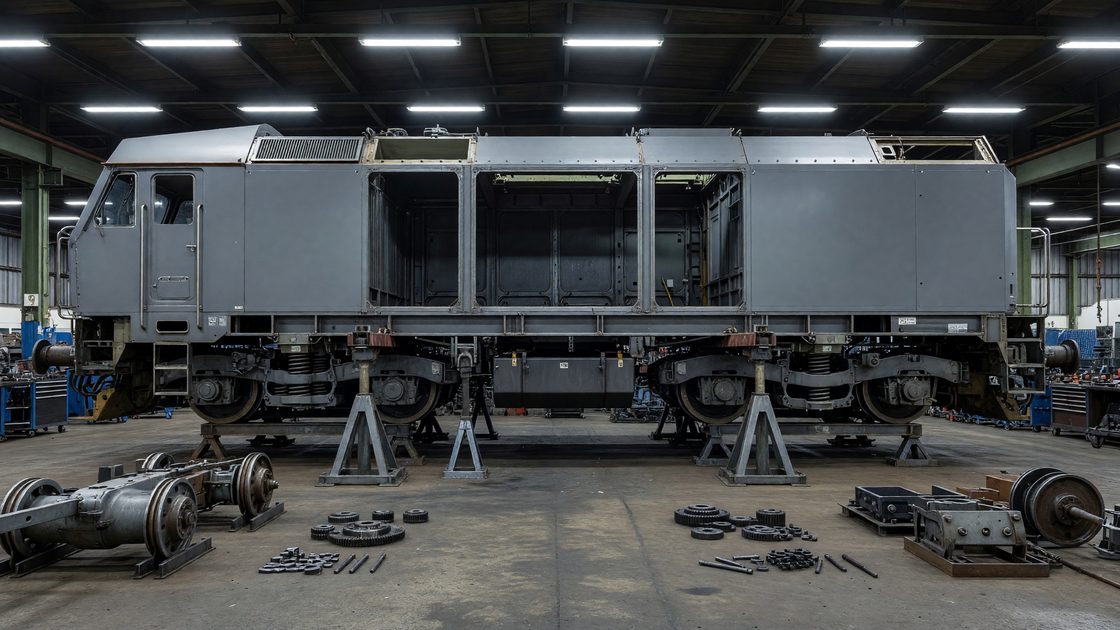
A locomotive’s underframe, truck castings, and major structural components are engineered to outlast several generations of the mechanical and electrical systems bolted to them. That gap between structural life and component life is the entire economic basis for locomotive remanufacturing: rather than scrapping a unit whose prime mover, traction system, or electrical cabinet has reached the end of economical repair, a remanufacturer strips the unit to its structural core and rebuilds or replaces everything else, extending service life by another decade or more at a fraction of new-locomotive cost. See our traction motor maintenance guide for how individual components fit into this larger picture.
What Gets Reused, and What Gets Replaced
A remanufacture program typically starts with a structural and non-destructive-testing (NDT) evaluation of the frame, fuel tank, and truck castings — the components with the longest genuine service life and the highest cost to replace outright. Frames that pass NDT inspection for cracks and fatigue are retained; those that do not are either repaired by qualified welding procedures or the unit is rejected from the program entirely.
Everything else is candidate for replacement or upgrade: the prime mover diesel engine is often replaced or completely overhauled to current emissions and fuel-efficiency standards, the traction system (generator/alternator and traction motors) may be upgraded from DC to AC if the economics support it, the electrical control cabinet is typically replaced wholesale with modern microprocessor-based control rather than repaired piecemeal, and the cab is rebuilt to current crashworthiness and ergonomic standards.
Emissions Compliance as a Remanufacturing Driver
EPA locomotive emissions standards (40 CFR Part 1033) apply differently to remanufactured locomotives than to new builds, and remanufacturing programs are frequently structured specifically around meeting a newer emissions tier without the full cost of a new locomotive. A prime mover replacement during remanufacture is often the point at which a unit moves from an older emissions tier to a current one, since the replacement engine is new production and certified to current standards even though the locomotive itself is a rebuild.
The Cost Case Against New-Unit Purchase
A remanufactured locomotive typically costs a fraction of a new locomotive’s purchase price while delivering most of the operational capability — a consideration that matters most for short lines, industrial railroads, and Class I fleets managing older-generation units that still have useful structural life left. The trade-off is that a remanufactured unit inherits its structural design era: axle loading, cab dimensions, and frame geometry are fixed by what the original structure supports, so a remanufacture cannot deliver every capability a clean-sheet new locomotive design offers. For many operating environments — yard switching, short-haul industrial service, branch-line road service — that trade-off favors remanufacturing; for high-utilization mainline road service, the calculus shifts toward new-unit purchase more often.
Truck and Running Gear Rebuild
Locomotive trucks (the wheeled assemblies supporting the frame) undergo their own rebuild scope during remanufacturing: wheel sets are re-profiled or replaced to current AAR wheel standards, traction motor mounts and gear cases are inspected and rebuilt, and suspension components (springs, snubbers, equalizers) are replaced as a matter of course rather than inspected piecemeal, since the labor cost of accessing them again before the next major overhaul cycle far exceeds the cost of the parts themselves.
Who Performs Remanufacturing Work
Locomotive remanufacturing is specialized heavy-industrial work, performed by a small number of shops nationally with the tooling, certifications, and structural-engineering capability to requalify a rebuilt frame and issue the documentation a railroad’s own mechanical department and the FRA require before a remanufactured unit re-enters revenue service. Some Class I railroads maintain in-house remanufacturing capability at major shop facilities; short lines and industrial railroads more often contract remanufacturing out, either to independent remanufacturers or to the locomotive OEMs’ own remanufacturing programs.
Documentation and Requalification
A remanufactured locomotive does not simply return to service on the strength of the shop’s own quality control — it requires documentation establishing that the structural, mechanical, and electrical systems meet applicable FRA requirements, often including a new or updated locomotive certification depending on the scope of work performed and whether the unit’s classification changes as a result (for instance, an emissions-tier change under EPA rules). Fleets evaluating a remanufacture program should confirm upfront what documentation package the remanufacturer will deliver, since gaps here can delay a unit’s return to revenue service well after the physical work is complete.
Electrical Cabinet and Control System Modernization
Older locomotives frequently carry electrical control systems built around relay logic and analog components that are increasingly difficult to source replacement parts for, since the original manufacturers have moved on to microprocessor-based control decades ago. A remanufacture program is often the practical point at which a fleet finally addresses this obsolescence problem, replacing an aging relay cabinet wholesale with modern microprocessor-based control rather than continuing to hunt for increasingly scarce replacement relays and analog components. This modernization carries operational benefits beyond simple parts availability: microprocessor control typically enables more sophisticated diagnostics, fault logging, and — where the fleet has invested in the supporting data infrastructure — the kind of condition data that feeds into modern predictive maintenance programs. A unit remanufactured with only a mechanical scope, leaving the original relay-based control cabinet in place, retains the parts-obsolescence problem even after the mechanical work is complete, which is why fleet managers evaluating remanufacture proposals should scrutinize the electrical scope as closely as the mechanical scope.
Evaluating a Remanufacture Candidate
Not every aging locomotive is a good remanufacture candidate. The evaluation starts with the structural assessment described above — a frame or truck casting that fails non-destructive testing removes a unit from consideration regardless of how attractive the rest of the economics look, since structural remediation of that severity typically costs more than the unit is worth once remanufactured. Beyond the structural pass/fail, fleet managers weigh a unit’s remaining duty-cycle fit: a locomotive being considered for remanufacture into an upgraded, higher-utilization role needs a stronger structural and cost case than one being remanufactured for a lighter, lower-mileage duty cycle it can serve for years without stressing whatever component life the rebuild delivers. Fleets that skip this duty-cycle matching step sometimes remanufacture a unit into a role that wears out its newly rebuilt components faster than the same investment would have in a better-matched assignment.
Frequently Asked Questions
How much does locomotive remanufacturing cost compared to buying new?
Remanufacturing typically costs a fraction of new-locomotive purchase price, though the exact ratio depends heavily on scope — a full prime mover replacement and AC traction upgrade costs considerably more than a more limited rebuild retaining the existing traction system. The economic case rests on reusing the structurally durable frame and truck castings rather than the shorter-lived mechanical and electrical systems.
What structural components get reused in a remanufactured locomotive?
The underframe, fuel tank, and truck castings are the primary structural components retained, provided they pass non-destructive testing for cracks and fatigue. These components are engineered for a service life well beyond that of the prime mover, traction motors, or electrical control systems, which is the entire economic premise of remanufacturing.
Does a remanufactured locomotive meet current emissions standards?
It depends on scope. A remanufacture that includes prime mover replacement typically moves the unit to a newer EPA emissions tier under 40 CFR Part 1033, since the replacement engine is certified separately from the rebuilt locomotive structure. A remanufacture that retains the original prime mover generally does not change the unit’s emissions tier.
Can a DC traction locomotive be upgraded to AC traction during remanufacturing?
Yes, when the economics support it — this is a common upgrade path during a major remanufacture, since it requires replacing the traction motors, generator/alternator, and control electronics regardless, and AC traction motors eliminate brush maintenance while generally improving adhesion performance. Whether the upgrade is worth the added cost depends on the unit’s intended duty cycle after remanufacture.
Sources
U.S. Environmental Protection Agency, 40 CFR Part 1033 — Control of Emissions from Locomotives, governs emissions requirements for remanufactured locomotives referenced above.